
Introduction
to Geosynthetic Certification Institute-Inspectors Certification Program for “Geosynthetic and Compacted Clay Liner
Materials”
(GCI-ICP)
The Geosynthetic Certification
Institute-Inspectors Certification Program (GCI-ICP) for “Geosynthetics Materials and/or Compacted Clay Liners” is
administered by the Geosynthetic Certification Institute which is a branch of
the Geosynthetic Institute. It is located in Folsom, Pennsylvania about
four-miles from the Philadelphia International Airport. Dr. George R.
Koerner (Program Director), and Dr. Robert M. Koerner (Oversight) and Ms. Jamie
Koerner (Administrator) are the principals involved.
Definition of CQA (as opposed to CQC)
Construction quality assurance (CQA) and
construction quality control (CQC) are widely recognized as critically
important factors in overall quality management for waste containment
facilities of all types. This includes
geosynthetic materials as well as natural soil materials. The best of designs and regulatory
requirements will not necessarily translate to facilities that are protective
of human health and environment unless they are properly constructed. Additionally, for geosynthetics, both
manufacturing quality assurance (MQA) and manufacturing quality control (MQC)
are equally important. Geosynthetics
refer to factory fabricated polymeric materials like geomembranes, geotextiles,
geonets, geogrids, geosynthetic clay liners, etc. The natural soils involved are compacted clay
liners and drainage soils of various types.
In this context, the definitions of CQA as contrasted to CQC are as
follows:
- Construction Quality Assurance
(CQA): A planned system of
activities that provides the owner and permitting agency assurance that
the facility was constructed as specified in the design. Construction quality assurance includes
inspectors, verifications, audits, and evaluations of materials and
workmanship necessary to determine and document the quality of the
constructed facility. Construction
quality assurance (CQA) refers to measures taken by the CQA organization
to assess if the installer or contractor is in compliance with the plans
and specifications for the project.
- Construction Quality Control
(CQC): A planned system of
inspections that is used to directly monitor and control the quality of a
construction project. Construction
quality control is normally performed by the geosynthetics installer, or for natural soil materials by the
earthwork contractor, and is necessary to achieve quality in the
constructed or installed system.
Construction quality control (CQC) refers to measures taken by the
installer or contractor to determine compliance with the requirements for
materials and workmanship as stated in the plans and specifications for
the project.
The certification
program to be described herein focuses on CQA but can (and should) pertain to
CQC as well. Two different programs are
offered; one is focused on geosynthetic materials and the other on compacted
clay liners. A candidate can take both
programs if desired.
The following flow
chart describes the interactions of MQA/CQA and MQC/CQC as they apply to a
particular project so as to produce an appropriate level of quality.
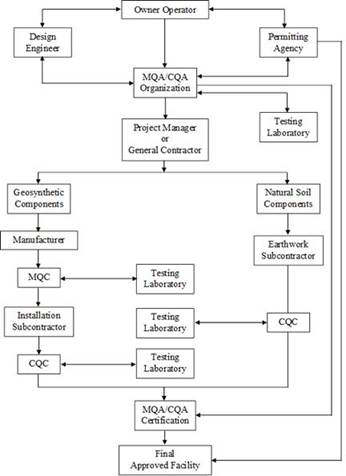
Figure 1 - Organizational Structure
of Quality Control and Quality Assurance Activities
*Note that this
certification program focuses on both geosynthetic and compacted clay liner
construction quality assurance (CQA) and only indirectly on manufacturing
quality assurance (MQA).
The Value
of CQA
The
electrical leak location survey (ELLS) method was developed in 1984 and was
slow to initially be implemented but for the past 10-years provided a wealth of
data on leaks of geomembranes placed in the field; both uncovered, and after
soil covering. For uncovered
geomembranes the water puddle technique (ASTM D6747 and D7002) is used and for
soil covered geomembrane the dipole technique (ASTM D6747 and D7007) is
used. The following photographs
(compliments of A. Rollin) show each technique being used.
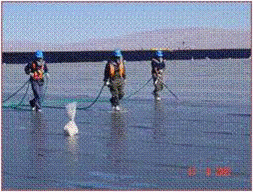
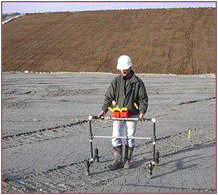
(a)
Water Puddle Technique
(b) Dipole Technique
Figure
2 - Electric Leak Location Survey Techniques
(photos
comp. TRI Environmental, Inc.)
In
a paper by Forget, Jacquelin and Rollin (2005) a
comparison of exposed geomembrane leakage without CQA and with CQA has been
generated. Figure 3 shows the incidence
of holes for these two situations. The
result is that an average of 22 leaks/ha (9.0 leaks/acre) occurred in 14
projects without CQA; whereas an average of 4 leaks/ha (1.6 leaks acre)
occurred in 43 projects with CQA.
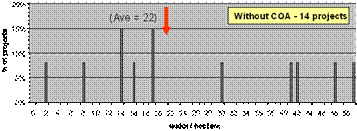
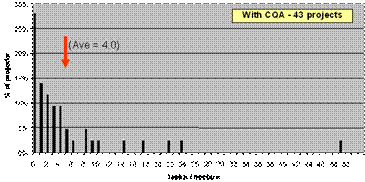
Figure
3 - Exposed Geomembrane Leakage Without and With CQA
(curves compl. A. Rollin, et al.,
2003)
The
situation for covered geomembranes [usually with 300 mm (or 12 in.) of sand or
gravel] is even more dramatic. The
result from 42-projects is that an average of 16 leaks/ha (6.5 leaks/acre)
occurred without CQA; whereas an average of only 0.5 leaks/ha (0.20 leaks/acre)
occurred with CQA.
This reference, and others, indicate
that there is a direct relationship between leak occurrence and the presence or
absence of a credible CQA program. Of
course, the tacit assumption is that a “credible” CQA program is being offered
and it is this program being described that will hopefully fill this need.