Geosynthetic Institute
PROSPECTUS
of
the
GEOSYNTHETIC
INSTITUTE
(GSI)
and
its
INTERRELATED INSTITUTES
January
1, 1996 – original
September
30, 1996 – rev. 1
June
22, 1998 – rev. 2
May
22, 2003 – rev. 3
April
13, 2005 – rev. 4
August
5, 2007 – rev. 5
February
15, 2019 – rev. 6
GSI’s Targeted Positions with Respect to
Organizations Involved with Geosynthetics
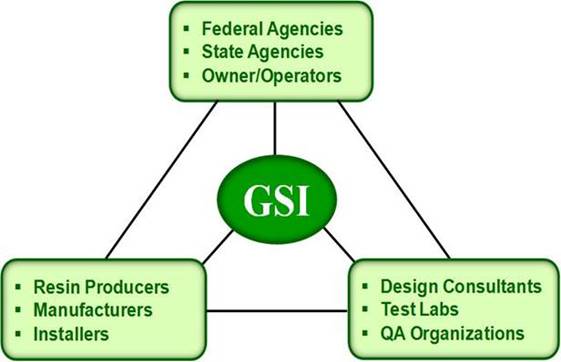
The following graphic
illustrates how the Geosynthetic Institute (GSI) and its interrelated
institutes are positioned to maintain a balance of activities between the three
major groups involved with geosynthetic materials, applications, and related
issues.
Clearly, those
organizations dealing with the public interest and having long-term liability
for systems which include geosynthetics have both the reason and need to be
involved in GSI. Thus public agencies
and private owners form one part of the triangle. These organizations usually regulate or
initiate a project and by so doing involve many others.
In
utilizing geosynthetic materials, both the manufacturers and their raw material
producers have an obvious direct involvement and form a second part of the
triangle. The raw materials involved are
polymer resins and the accompanying carbon blacks, additives, stabilizers and
anti-oxidants. Contractors and
installation companies also form a critical role in this group.
The
third part of the triangle consists of the group which interfaces directly with
the other two groups. They are the
design consultants, testing laboratories and associated monitoring
organizations who develop site specific plans, specifications and quality
assurance documents.
All
of these organizations are essential components of GSI and its affiliated
institutes for the proper use and understanding of geosynthetic materials and
their myriad applications.
GEOSYNTHETIC INSTITUTE
(GSI)
Background
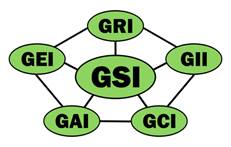
· GSI is the umbrella organization for the
following interrelated institutes;
1. Geosynthetic Research Institute (GRI)
2. Geosynthetic Information Institute (GII)
3. Geosynthetic Education Institute (GEI),
4. Geosynthetic Accreditation Institute
(GAI)
5. Geosynthetic Certification Institute
(GCI)
· GSI was incorporated in the State of
Delaware on December 16, 1991.
· GSI is an independent, not-for-profit
501(c) (3) organization as of September 17, 1993.
· GSI is established through Institute
Bylaws approved on December 11, 1994.
· GSI is advised by a 9-person, member
elected board of advisors.
· GSI is supported by annual membership
subscription, income from its interrelated institutes, and research
contracts/grants/awards.
· The location of GSI is about 3 miles (4
km) from the Philadelphia International Airport.
Geosynthetic Institute
475 Kedron Avenue
Folsom, PA 191033-1208 USA
Phone: (610)
522-8440
Fax: (610) 522-8441
E-mail: marilyn@geosynthetic-institute.org
The
Mission of GSI
GSI
constitutes a diverse assembly of agencies, corporations, companies,
partnerships, and groups who actively engage in the manufacturing, design and
use of geosynthetics as engineering materials.
The GSI mission is to develop and transfer knowledge, assess and
critique geosynthetics, and provide service to the member organizations.
Geosynthetics
consist of the following polymeric materials used in environmental,
geotechnical, transportation, hydraulic engineering, and private development
applications:
·
geotextiles
– porous textiles
·
geomembranes
– impermeable liners
·
geogrids
– reinforcement grids
·
geonets
and geopacers – drainage composites
·
geosynthetic
clay liners –bentonite layers in/on other geosynthetics
·
geopipe
– buried plastic pipe
·
geofoam
– lightweight fill
·
geocomposites
– various assemblages of geosynthetic and sometimes soil materials
The Goals and Objectives of GSI
The
goals and objectives of GSI are to develop, investigate and implement the
various facets of geosynthetics recognizing them as engineering materials. This includes, but is not limited to, the
following specific tasks:
1.
Conduct
applied research on the engineering aspects of geosynthetics.
2.
Conduct
basic research on resins, additives, stabilizers, antioxidants, fillers and
modifiers used to manufacture geosynthetics.
3.
Develop
test methods, standards of practice, standard guides, and product
specifications for manufacturing, design and installation.
4.
Provide
and implement geosynthetic certification and accreditation procedures.
5.
Provide
training and tutorial services to member organizations and their employees.
6.
Develop
and provide courses, conferences, symposia, workshops, webinars and training
sessions.
7.
Provide
geosynthetics information retrieval services.
8.
Provide
publications in the form of newsletters, books, manuals, reports, journals,
papers, articles, notes, and memos.
9.
Provide
forensic services on both field successes and failures.
10.
Provide
conflict resolution services between and/or on behalf of member organizations
Within the above specific tasks it is
the goal and objective of GSI to be the conscience of the industry and to provide
an ongoing and sustainable center of excellence for all types of geosynthetics.
Affiliated Organizations
In order to provide geosynthetics-related
global outreach, a number of associations called “affiliated organizations”
have been implemented, e.g., GSI-Korea, GSI-Taiwan and GSI-India. Their mandate is to provide for technology
transfer from GSI to their respective countries in their native language and to
develop research and development focused on their particular situations.
Centers of Excellence
In specific application areas
where the use of geosynthetics is underutilized, centers of excellence can be
initiated accordingly. Such centers are
typically with universities where such expertise exists. Examples are geosynthetics in reinforcement
applications, hydraulic engineering applications, etc.
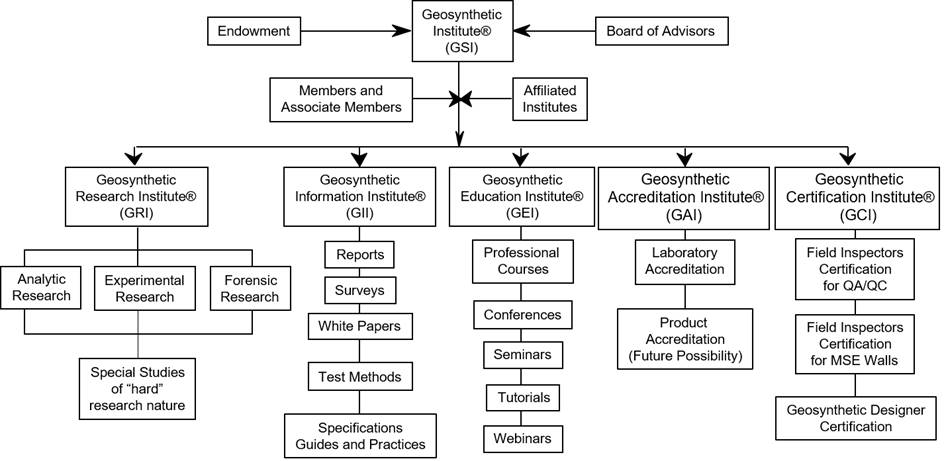
The Structure of the Geosynthetic
Institute (GSI)
Along
With Its
Interrelated Institutes
GSI’s
Interrelated Institutes
1. Geosynthetic Research Institute (GRI)
·
Incorporated
in the State of Delaware on August 12, 1986 as Geosynthetic Research
Incorporated.
·
Name
amended to Geosynthetic Research Institute on March 3, 1989.
·
Sometimes
affiliated with Drexel University in Philadelphia, Pennsylvania.
·
Permanent
staff who are assisted by technicians and graduate students.
·
Approximately
10 research projects are presently ongoing.
·
Included
in these research projects are environmental related applications, transportation/geotechnical
related applications and hydraulic related applications.
·
Most
projects are long-term in their duration (generally, short-term projects are
referred to the member organizations; mainly consultants and testing
laboratories).
·
Major
projects on lifetime prediction of HDPE, LLDPE, fPP and EPDM geomembranes, PP
and PET geotextiles, HDPE and PET geogrids, and HDPE geopipes are ongoing..
·
Evaluation
of the behavior of antioxidants in geosynthetic formulations is an ongoing
study.
·
Creep
behavior of geomembrane seams and puncture as well as midplane creep shear of
hydrated GCL’s are also being evaluated.
·
Life
cycle benefits of geotextiles separators in extending highway pavement
performance is also a priority effort.
·
In-situ
monitoring of landfills insofar as liner and cover temperatures, waste
degradation over time, and behavior of leachate collection systems.
·
Filtration
and drainage of tailings and residual materials
Information on GRI can be
obtained from:
Dr. Y. (Grace) Hsuan
Assistant Director of GRI
Geosynthetic Institute
475 Kedron Avenue
Folsom, PA 19033-1208 USA
Phone: (610)
522-8440
Fax: (610) 522-8441
E-mail: hsuanyg@drexel.edu
2. Geosynthetic Information Institute (GII)
·
The
GII provides technical information to all of the GSI member organizations.
·
Information
is daylighted in hard copy by means of a quarterly Newsletter/Report. Each of the institutes are highlighted and
their respective programs are reviewed and updated.
·
Information
is also daylighted on the Internet via our website which is accessed via
<www.geosynthetic-institute.org>.
·
This
website has separate sections on
-
background/prospectus
-
current
member organizations
-
guides
and specifications
-
public
information
-
member
information
·
The
public information file has multiple parts including links to most of the
geosynthetics community and an updated list of laboratories with their
accredited test methods.
·
The
member information file is accessed only by password. It includes test methods, proprietary report
titles/abstracts, a key word search of the geosynthetic literature (approx.
30,000 citations), example problems, and frequently asked questions and
answers.
·
Specific,
project related, information is interactively obtained by member organizations
via the website.
·
General
geosynthetic information is available on-line (free to anyone) in the form of
answers and questions at GMATechline@ifai.com
·
GII
develops geosynthetic product specifications.
As such, the specific test methods, minimum (or maximum) property values
and recommended frequency of testing are prescribed. They are available free to everyone who has
an interest.
·
GII
also develops geosynthetic test methods, guides, and practices. These items are intended to function until
other groups, such as ASTM or ISO, develop standards of their own.
·
These
standards are available as a published set and currently comprise 66 separate
standards documents.
Information on GII is
available from:
Ms. Marilyn Ashley
Executive Secretary
475 Kedron Avenue
Folsom, PA 19033-1208 USA
Phone: (610)
522-8440
Fax: (610) 522-8441
E-mail: marilyn@geosynthetic-institute.org
3. Geosynthetic Education Institute (GEI)
· The Geosynthetic Education Institute
offers both courses and webinars on an ongoing basis. There are currently 27 GSI webinars, 21 ASCE
webinars and 3 courses available. The topics are related to geosynthetics in
the following applications:
-
waste
containment
-
transport/geotech
-
hydraulics
-
walls
and slopes
-
private
development
-
QC
and QA of geosynthetics
· Distance learning of the above courses
can be described as interactive internet learning which is available at the
time, location and discretion of the user/student.
· The sixth edition of “Designing with
Geosynthetics” Volumes I and II (2012) is available in hardback, softback and
e-book.
· “Geotextiles from Design to
Applications”, edited by R.M. Koerner is available in hardback and e-book.
· Upon passing a quiz on the subject
matter, continuing education credits, i.e., PDHs are available.
· Past conference themes have been on
durability, seaming, resins/manufacturing, landfill closures,
filtration/drainage, soft soil stabilization, infrastructure remediation,
performance, etc. Full proceedings of
all papers presented at the 25 conferences are available.
· Briefings and seminars are available to
member organizations at their facilities on an annual basis. The topics are mutually decided upon and the
sessions last from 2 to 4 hours.
· Tutorials (mainly for laboratory
managers and technicians) are available to member organizations at GSI’s
facilities.
Information can be obtained from:
Ms. Marilyn Ashley
Executive Secretary
475 Kedron Avenue
Folsom, PA 19033-1208 USA
Phone: (610) 522-8440
Fax: (610) 522-8441
E-mail: marilyn@geosynthetic-institute.org
4. Geosynthetic
Accreditation Institute (GAI)
·
The
major activity of GAI at the present time is the geosynthetic testing
laboratory accreditation program, or “GAI-LAP”.
·
This
is a hybrid program which accredits individual tests involving geosynthetic
materials.
·
The
program requires a quality manual modeled after ISO 9000.
·
The
laboratory protocol is modeled after ISO Guide 17025 and 17011
·
Also
required are standard operating procedures and test result reports of all tests
to be accredited.
·
An
on-site audit is made and test results are compared to the GAI established
database for acceptance/rejection.
·
For
the 2nd, 3rd and 4th years, continued
accreditation is based on proficiency testing.
·
Samples
of various geosynthetic materials are sent to the respective laboratories,
tested by them, and results compared to the GAI database. Results from the laboratories must be within ± 2s of the mean value in order for the
laboratory to remain accredited for the test method under consideration.
·
The
5th year is another on-site audit and then the cycle repeats itself.
·
The
program has accredited 106 laboratories having 257 tests under accreditation.
·
The
program is now venturing into other than ASTM tests, i.e., ISO tests, and into
accrediting international laboratories.
·
The
program publishes a directory in December of each year.
·
The
up-to-date listing of laboratories and their accredited test methods is
maintained on the institute’s website which is accessed by <geosynthetic-institute.org>.
Information can be obtained from:
Dr. George R. Koerner, CQA
Director
475 Kedron Avenue
Folsom, PA 19033-1208 USA
Phone: (610) 522-8440
Fax: (610) 522-8441
E-mail: gsigeokoerner@gmail.com
5. Geosynthetic Certification Institute (GCI)
·
GCI’s
Inspectors Certification Program (GCI-ICP) began in January, 2006 with the Construction
Quality Assurance (CQA) for Geosynthetic Materials and Compacted Clay Liners.
·
While
landfills, surface impoundments, and waste/heap leach piles are the main
applications, all types of geosynthetics installations are applicable.
·
In
2012 the GCI Program was expanded to include the Inspectors Certification
Program for MSE Walls, Berms and Slopes.
·
Candidates
for successful certification for these two programs require:
o
recommendation
by superior
o
minimum
6-mos. field experience
o
acceptable
personal resume
o
successfully
pass a proctored multiple choice examination
·
The
most recent GCI program, Geosynthetic
Designer Certification Program started in 2016. The requirements for certification are as
follows:
o
Candidate
must hold a degree from an accredited engineering university
o
Be
a professional engineer
o
Minimum
6 months of geosynthetics design experience.
o
Successfully
pass a 45-question numeric examination that follows directly with the 6th
Edition of Designing with Geosynthetics textbook.
·
An
11-person steering committee gives oversight and updates the above examinations
on a mutual basis.
Information
can be obtained from:
Ms. Jamie Roth Koerner
Office Manager
475 Kedron Avenue
Folsom, PA 19033-1208 USA
Phone:
(610) 522-8440
Fax: (610) 522-8441
E-mail: jamie@geosynthetic-institute.org
Membership Privileges
GSI provides for its
members the privileges that are listed below:
1.
Voting
in all GSI matters
2.
Eligibility
for board of directors
3.
Annual
traveling in-house seminar
4.
Training
at GSI laboratories
5.
Input
as to research project selection
6.
Guidance
and critique of research projects
7.
Proprietary
reports on the results of research projects
8.
Survey
results on specific topics involving geosynthetics
9.
Access
to “Members Only” portion of the Home Page on the Internet
10.
Keyword
search on the geosynthetic literature on the GSI Website
11.
Member
information posted on the GSI Website
12.
Direct
linkage, i.e., “hot wiring” to individual member organizations Home Pages
13.
Peer
review of manuals, brochures, reports, concepts, and related information
14.
Direct
contact and relations with respect to litigious and insurance matters
15.
Annual
meeting attendance
16.
Focus
group participation
17.
Briefings
and tutorials at GSI
18.
Discounts
on webinars and on-line courses
19.
Data
from all affiliated institutes
20.
Development
of GRI standard test methods/practices/guides/specifications
21.
Quarterly
Newsletter Reports
22.
Discounts
on publications
23.
Presentations
at GRI conferences
24.
Document/brochure/project
guidance and advice on an as-required basis
25.
Direct
and immediate consultation with GSI personnel and staff at any time
26.
Conflict
resolution services between, or on behalf of, member organizations
Membership
Fees
Time
|
Full
Member
|
Associate*
|
|
First
Year Subsequent
Years |
$10,000 $10,000 |
$1000 $1000 |
*Only for State and Governmental Agencies
Summary
·
The
Geosynthetic Institute (GSI) is the umbrella organization which directs and
guides its affiliated institutes. The
interrelated institutes are GRI, GII, GEI, GAI and GCI as described in this
prospectus.
·
Membership
in GSI automatically brings full membership to all of the interrelated
institutes.
·
An
Associate Membership status (at the present reduced fee of $1000 per year) is
available for Federal, State and Governmental Agencies.
·
Bylaws
of GSI are available upon request.
·
GSI
functions through advice by its nine person Board of Advisors.
·
GSI
operates via a Director, Associate Director and associated staff and
colleagues.
·
GSI
and its interrelated institutes (such as GRI, GAI, etc.) are funded by
contracts, grants and consortium fees from the member organizations.
·
Since
GSI is a nonprofit organization under the IRS 501(c) (3) tax-free status, an
Endowment Fund exists. It is in existence
and is supervised by a Financial Oversight Committee.
·
Funds
are hereby solicited via special projects, honoraria, corporate gifts and
personal gifts.
·
Affiliated-Organizations
are based within non-U.S. agencies and/or universities in which English is not
the major language and are formed to provide geosynthetics outreach in an
orderly and proactive manner.
·
For
additional information regarding this prospectus and/or questions on the
activities described herein please contact:
Dr. George R. Koerner
Geosynthetic Institute – Director
475
Kedron Avenue
Folsom,
PA 19033-1208 USA
Phone:
(610) 522-8440
Fax:
(610) 522-8441
E-mail: gsigeokoerner@gmail.com